Engineering dossier · RM 010
A skeleton watch exposes alignment and depth that a closed dial can hide. The case, movement display, date and strap must be reviewed as one assembly.
This Richard Mille RM 010 superclone guide uses the official historical RM 010 as an engineering baseline. Richard Mille introduced the model in 2006 with calibre RMAS7, a skeletonized automatic movement displaying hours, minutes and date with a variable-geometry rotor. The genuine case measured 48 mm by 39.30 mm by 13.84 mm.
Those specifications identify the genuine watch. A store configuration must separately document its case, movement, rotor presentation and water-resistance evidence. Skeletonization makes visual comparison detailed, but visible resemblance does not establish material composition or internal performance.
Richard Mille RM 010 superclone guide: lock the reference geometry
The RM 010 enlarged the earlier RM 005 format and increased skeletonization while retaining the basic gear-train concept. Its tonneau case must be evaluated in three dimensions: width, height, thickness, curvature and the relationship between front and back bezels. A flat front photograph cannot show that architecture.
Request straight, side, top and underside views from similar distance. Compare screw seating, gasket line, crown projection and the way the strap enters the case. Measurements, when supplied, must identify the exact unit and measurement points; a domed crystal or curved back can change caliper placement.
RMAS7 genuine baseline and installed movement claim
Richard Mille identifies RMAS7 as a skeletonized automatic movement with hours, minutes, date and variable-geometry rotor. A seller should state whether its RMAS7 wording describes visual decoration, functional arrangement, rotor styling or a claimed clone architecture. Those are different product statements.
Photograph the movement from front and back under diffuse light. Look for alignment, loose debris, screw damage, rotor clearance and consistent surface treatment. A short winding and setting video can document function. Reserve, regulation and rotor adjustment require separate testing or inspection.
| Checkpoint | Genuine reference baseline | Evidence for the selected unit |
|---|---|---|
| Case | Official RM 010: 48 x 39.30 x 13.84 mm | Unit measurement with stated points if supplied |
| Movement | Genuine RMAS7 automatic, date, variable-geometry rotor | Installed architecture and rotor claim clarified |
| Skeleton display | Reference-specific layered front/back architecture | Sharp unfiltered images and hand-clearance video |
| Materials | Official reference materials are model-specific | Product material documentation or exact seller statement |
| Water resistance | Official historical RM 010 stated at 50 m | Separate pressure result for selected unit |
Skeleton dial depth, date and hand clearance
A skeleton display should be checked layer by layer. Inspect the chapter ring, numerals or markers, hands, date aperture, visible bridges and background components. The hands must clear one another and the applied elements. Ask for the hands moved away from the date and key visual structures in at least one photograph.
The date should sit correctly in its window and advance without binding. Strong sharpening can create false edges across openworked components, so request original-resolution images without a beauty filter. Neutral light helps distinguish actual coating differences from reflections.
- Front, back and both case-side images
- Top and underside curvature views
- Movement photographed under diffuse light
- Winding, setting and date-change video
- All case screws and crown examined
- Strap attachments and buckle documented
Case screws, crown and material descriptions
Review every visible screw as part of the case system. Check seating depth, head condition and consistency rather than expecting decorative orientation to prove assembly quality. Crown operation should feel deliberate through winding and setting positions. After operation, confirm it returns to the secured position specified for the product.
Material terms such as titanium, ceramic, carbon or plated color should be tied to the selected configuration. A photograph alone cannot verify alloy grade. If weight is supplied, record strap and buckle fitted, because those components materially affect the result.
Strap, buckle and curved-case fit
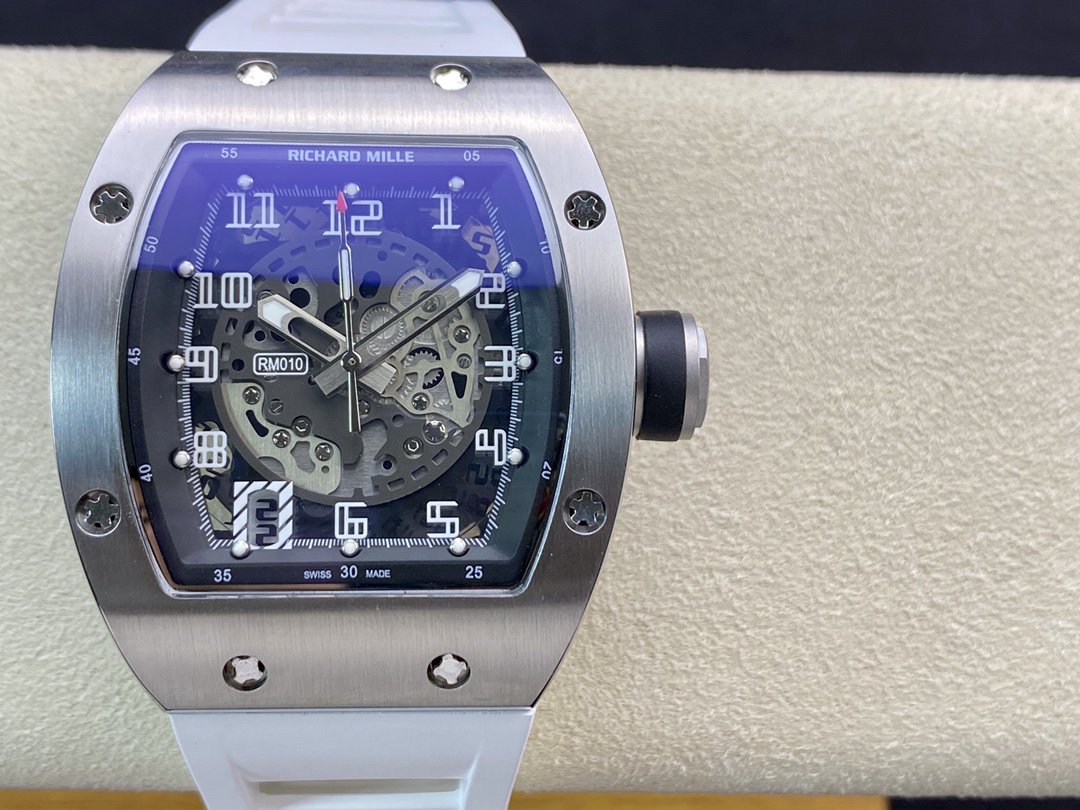
The strap must follow the tonneau case without a large unintended gap or twist. Photograph both attachment points and the underside. Confirm strap width, length, material, color and supplied buckle. A white strap, as used on the selected product example, will show handling marks readily and should be inspected before dispatch.
Buckle closure, keeper position and hole condition affect daily wear. If a replacement strap is planned, source it by exact case connection and buckle size. A generic strap that appears similar may not reproduce the required curvature or screw placement.
Control perspective in tonneau-case photography
Tonneau cases distort quickly when photographed too near the lens. Use a level camera farther from the watch with modest optical zoom for the identity image. Then photograph the top and bottom curvature separately. This makes the relative width of the bezels, center case and strap openings easier to compare.
Place both side views at the same distance and height. Record the crown side with the crown secured and again only if a controlled setting demonstration is needed. A measurement photograph should show caliper contact points; a number without the method cannot resolve a case-proportion question.
First-week ownership observations
Record winding feel, date change, rotor behavior and timekeeping during normal wear. Note whether the watch was stationary or worn when an observation was made. Skeletonized layouts make dust or a loose visible component easier to notice; stop operation if contact or debris appears rather than trying to dislodge it.
Inspect the light-colored strap for transfer marks at delivery so later wear is distinguishable. Keep the product photos, QC set and first-week notes together. If service is needed, provide the installed movement statement and clear symptom evidence before any case opening is approved.
Openworked architecture produces strong reflections, so review the front and back under diffuse light before judging surface treatment. Identify the balance area, rotor, date display and fixed bridge shapes visible in this configuration, then compare like-for-like views with the rotor in similar positions. A decorated component documents the intended visual layout but cannot prove calibre origin, material grade or adjustment. Verify operation separately through winding, setting, date transition and a dated timing observation. Keep every conclusion tied to the selected unit rather than applying it to all RM 010 configurations.
Also retain one uncompressed caseback image with the rotor moved aside and a second with it in a different position. The pair exposes more of the fixed architecture and gives service support a clearer visual baseline.
Build the final approval record
Review the RM 010 white-strap configuration and keep its product-level movement statement separate from the official RMAS7 baseline. The Cartier Santos guide provides a contrasting approach to bracelet and case integration.
Save the selected material/color, movement description, strap package, measurement record and QC files under the same configuration. If a different strap or buckle is substituted, update the record before approval.
Reference sources: Richard Mille’s official historical RM 010 Automatic reference page.
Buyer questions